
October 2023Read essay →
From Traffic Lights to Life’s Direction
Explores how traffic-light timing might be inferred from crowdsourced trajectories, alongside reflections from Wolfram Summer School.
MediumFull page ↗
What makes a piece of work worth doing, and what does it ask of the people who take part?
In 2023 I wrote down a question I was struggling to answer. I wanted to work on problems that mattered to me. Which of them could I keep working on while earning a living and looking after my family?
I still want to build a business that can pay its own way and give other people room to pursue work they care about. A competitive market makes it easy to judge a decision by whether it helped the business survive. Even when we have played by the rules, I want to ask who had a say in that decision and who had to live with it.
When a neighbour and I began talking about technology for older adults, a practical question was how much trouble someone had to go through just to use an app. That is the kind of detail I want to keep in view when I build something, write about it, or invite someone else to try it.
“我们都在穷尽自己仅有的一点天赋,来表达内心深处的感受”
We spend our whole lives exhausting our modest gifts to express what lies deep in the soul—and, as my family motto reminds me, “但行好事,莫问前程” (do good work wholeheartedly, without fixating on the reward ahead).
The Story of a Million Stars: a Complex Adaptive System
Making Sense in 50 Milliseconds—From Red Lights to Ad Auctions
Designing AI That Keeps Us in the Driver’s Seat
Civilization: It Takes All Kinds
Choose a path for a suggested piece, or open any essay directly.
Start with a founder’s account of the need, then examine the work behind it.
How a conversation with a neighbour led me to start Kin Domi for older adults.
What older drivers told me about using self-driving, and the changes I proposed after listening to them.
How much control does someone have over a tool they depend on?
A design for a household agent that learns through conversation. What should it be allowed to remember or do on its own?
Notes from older drivers on how sudden alerts and touchscreens get in the way, and why calmer feedback and voice control matter.
What can I still do for myself after I close the chat?
A working hypothesis on following curiosity to the frontier, with four proposed capability courses yet to be tested.
An earlier protocol for testing whether making a design decision myself helps me remember how to make the next one.
Simulating 662,772 globular clusters and 17.88 million binary black holes at UT Arlington, watching a million stars rearrange themselves, and finding that the same feedback rules traffic, auctions and teams.
Look at a globular cluster through a backyard telescope and it appears frozen—a quiet snow globe of a million stars packed into a sphere a few parsecs wide. Speed up the clock to an 800-million-year relaxation time (τ_rh), however, and that snow globe turns into a restless gravitational engine. Heavy black holes lose kinetic energy to lighter stars, sink to the core, and lock into tight binary dances.
In my doctoral work at UT Arlington, I ran and synthesized 3,240 MOCCA cluster simulations across 8,946 galaxies within 30 Mpc. That cosmic census revealed 17.88 million inspiralling binary black holes, a local merger rate of η ≃ 587 Gpc⁻³ yr⁻¹, and 17 LISA “standard sirens” pinpointed tightly enough (ΔV ≤ 1 Mpc³) to measure the expansion of the universe independently of starlight.
Reverse-engineering a traffic-light countdown, writing down an ad-serving path that keeps its tail latency down without shrinking the model, and asking what the Growth Trap does to the people on the other side of the screen.
Sitting at a red light at an empty intersection one morning, I found myself doing the math: why do cities still run intersections on blind, fixed timers when approaching cars already carry GPS sensors? Even if only a fraction of vehicles share telemetry, pairing that sparse data with physical conservation laws (like Stephen Wolfram’s symbolic-neural hybrids) lets a system infer queue lengths and clear traffic dynamically.
The same structural puzzle came back in advertising. A serving path has to answer inside the latency budget the platform allows, and the trade-off is stated bluntly in Rethinking Digital Advertising: real-time ad platforms cannot tolerate the latency that AppLovin’s models can, and that headroom is exactly what buys larger models and better personalisation. So I wrote the system down instead of the slogan — a real-time ingestion pipeline and feature store feeding a labelling and profile service, which feeds a dynamic ad-serving path with in-session creative switching, backed by distilled user profiles so candidate generation stays cheap.
The rest of the argument matters more than the plumbing. If you optimise only for immediate clicks, you exhaust the audience: that is the Growth Trap, where consumer fatigue, regulatory risk and competitive erosion meet. A system that serves a decision in milliseconds still has to answer the slower question underneath it — whether the decision is worth making at all.
The pipeline as specified in Rethinking Digital Advertising: From Guesswork to User Engagement — the two middle stages are the ones that decide whether a fast decision is also a good one. The dashed line is the loop the essay keeps closing: distilled profiles feed candidate generation back into the serving path.
The estimator designed in From Traffic Lights to Life’s Direction (Medium, 2023): devices report whether they stopped or passed, a crowd reports the state directly, and a square wave is fitted to those observations. This is a re-implementation of that design against a synthetic intersection with a known ground truth — not a measurement of a deployed system.
Estimated GREEN · changes in 16s · 83% confidence
The truth is GREEN changing in 15s · 32 of 36 observations align with the fitted cycle · crowd reports GREEN. Confidence follows the essay’s definition: the share of aligned data points, discounted by the historical accuracy of previous estimates.
Explores how traffic-light timing might be inferred from crowdsourced trajectories, alongside reflections from Wolfram Summer School.
The living repository edition of the AppLovin essay: the four growth drivers, the four areas where the paradigm is shifting, the growth trap, and the author’s own account of where the work came from.
Proposes richer intent models, compact user profiles and interfaces that let users request different advertisements.
Examines how advertising systems can move from static demographic targeting to dynamic demand profiling and explicit user preference loops.
An analysis of behavioural data, scaling and latency constraints in advertising, with questions about the costs of continued growth.
Uses the visual ergonomics of dark mode as a case study to critique short-term agile feature shipping versus long-term user welfare.
An exploration of documentation bottlenecks, the bandwidth of speech and writing, and institutional information barriers.
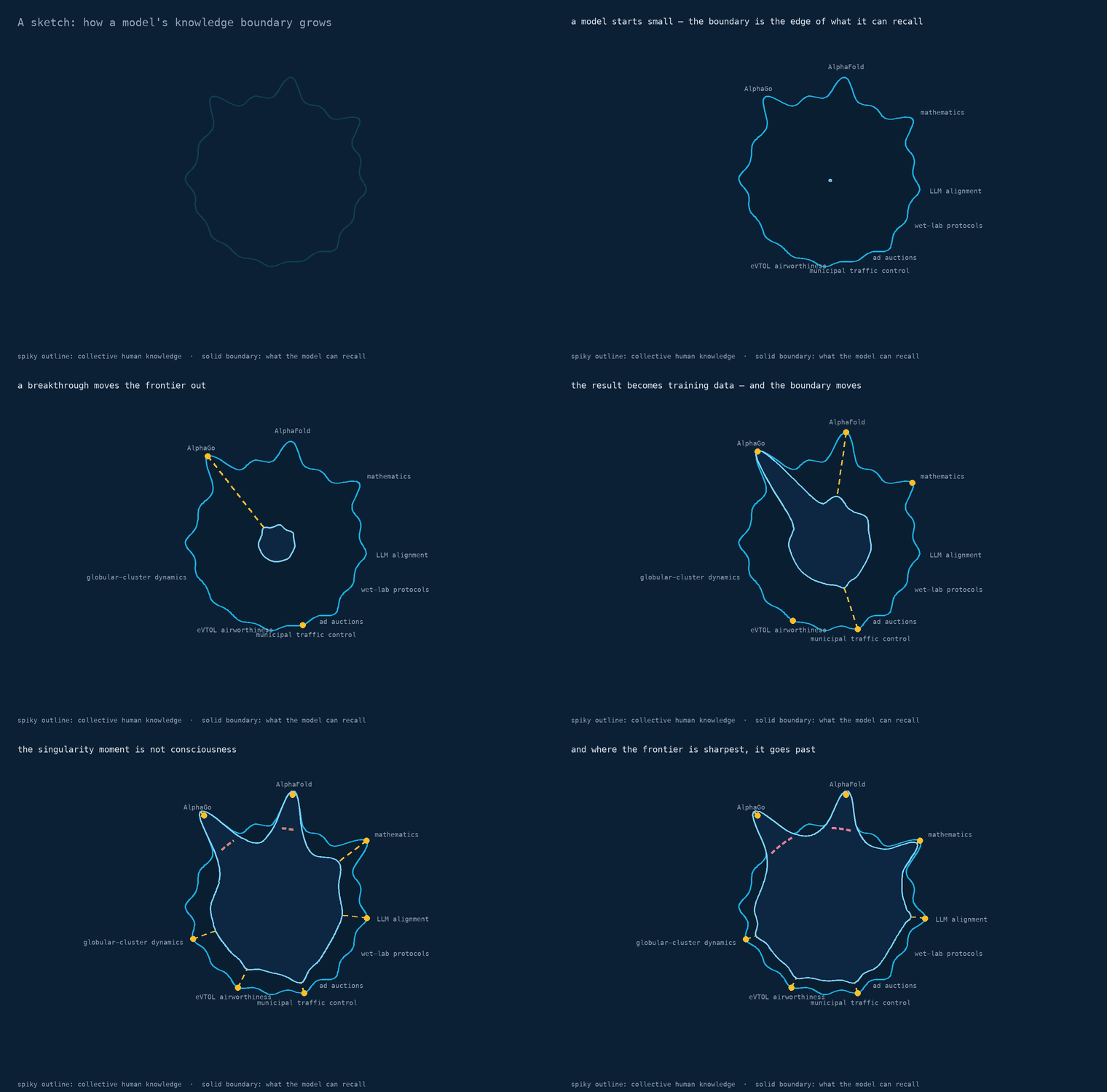
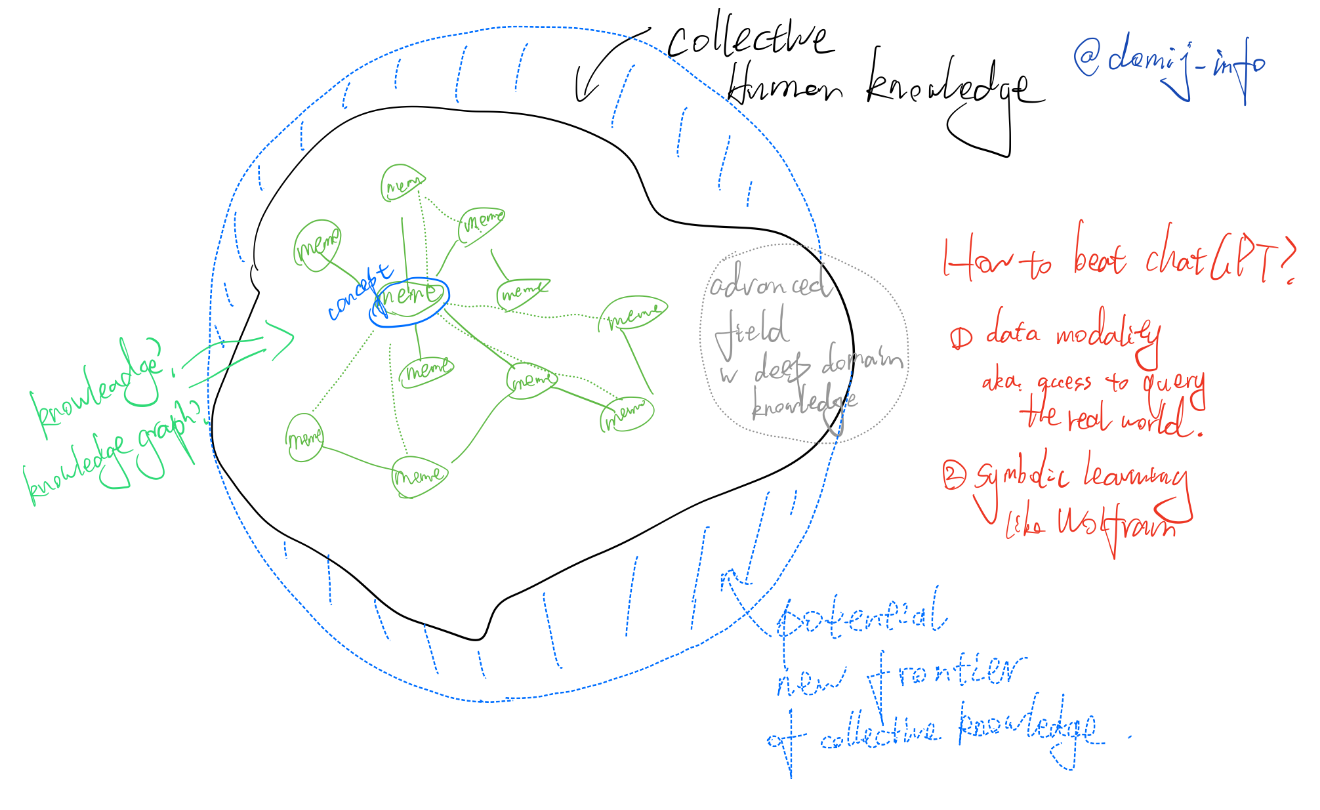
Still a sketch, and probably wrong in places. This is the model I keep redrawing — a language model as correlated memories, one of them conditioned at a time — with the two ways out I keep thinking about. I would rather hear where it breaks than defend it.
Riding in self-driving Teslas with Palo Alto seniors, reclaiming play as lifelong curiosity, and building local tools that sharpen human judgment instead of replacing it.
Explore how two people learn from their different knowledge maps →In late 2024 I stepped outside pure software loops to start Kin Domi in Palo Alto—spending afternoons in living rooms, community centers, and passenger seats with older adults. Watching seniors use Tesla’s Full Self-Driving (FSD) showed me something no benchmark captures: older drivers have the most to gain from autonomous mobility, yet cockpit alerts are built for thirty-year-old engineers. Sudden takeover chimes and tiny icons create panic at the exact moment calm reassurance is needed.
When I wrote Reclaiming Play as a Life Skill, several older readers gently told me they disliked the word “play” because it sounded childish. That conversation reshaped how I build: what people want at every age is dignified self-reliance, low-stakes curiosity, and a partner that respects their judgment—whether in Open Learning Lab, baby-AI, or iMessage AI Router.
Paste a prompt and let the model define the problem for you.
State your own hypothesis and constraints first, before any AI generation begins.
In Tesla FSD ride-alongs: showing clear route intent on screen before the car starts a turn.
Notes on customer research, community outreach and forming the team behind Kin Domi, Inc.
Observations from work with older adults at Kin Domi, alongside six proposals for more accessible driving-assistance interfaces.
Examines Jane McGonigal's game mechanics (goals, rules, feedback systems, voluntary participation) through conversations with senior learners and retirees.
Notes on how shared reading context, explicit expectations and active reflection improve comprehension across languages and disciplines.
A working hypothesis connecting four proposed courses—effective altruism, future thinking, design thinking and positive psychology—with purpose, potentials, communication and resilience, alongside three independent learning-experience principles.
A native Mermaid and plain-text decoding of the 10 March 2023 XMind map (Design for Learning), restoring every branch, boundary annotation, summary frame, icon marker and reference link in place of serving the raw PDF.
An open research ledger testing which LLM-mediated learning policies produce durable, transferable capability per unit of learner effort outside the tutoring session.
Five subsystem specifications for perception, speech, memory, adaptation and evaluation, with a hardware cost target below $200.
An experiment in using messaging to reach internet-connected agents over limited connections, including in-flight Wi-Fi and satellite text.
An architectural discussion of personal AI memory, local voice processing, privacy in query rewriting and browser context.
Examines the mechanics of coaching, intellectual honesty, and why shared context determines the effectiveness of feedback.
From human capital in an ‘organized farm’ to organizing intelligence with empowered individuals — and a proposed measure of a resilient, capable team: collective competence with mission alignment, holding diversity and individuality at once.
Why do some teams compound curiosity into generational breakthroughs while others with ten times the capital stall? Whether comparing Boeing and SpaceX, studying eVTOL airworthiness across the US and China, or reflecting on our own responsibilities as builders, the bottleneck is rarely raw IQ. It is whether incentives reward first-principles honesty over short-term optics.
In my Substack essays and the civic notebook LibertyEarth, I use a simple mathematical picture for healthy collaboration: treat shared ethical values as the Greatest Common Divisor (GCD) that keeps baseline trust high, and treat complementary human + AI skills as the Least Common Multiple (LCM) that expands what we can build together—anchored day to day by the eighth revision of the work model I keep in my founder's log.
Shared values and complementary skills are the mechanism; what they are for is collective competence. The institutions I have worked in still organize people the way an organized farm organizes capital: interchangeable units, measured by output, replaceable when the season turns. That shape does not survive the move to organizing intelligence with empowered individuals. So I am trying to measure a resilient, capable team instead: collective competence — what the group can do that none of its members could do alone, held together by one mission, and sustained by leaving every person's difference intact. All three have to hold at once. Take the mission away and the team is a queue; take the individuality away and it is a crowd. The Avengers are the reference case — nobody interchangeable, everybody committed to the same thing.
Opening essay on writing transparently, learning from practical execution and empowering collaborative solutions to social challenges.
A reflection on team alignment, complementary skills and sustainable working habits.
A personal reflection on connections between astrophysics, Confucian ethics and work across disciplines.
Reflections on sustaining execution cadence, small compounding wins and community discovery during early venture building.
Notes on the eighth revision of a working model built around shared calendars, asynchronous collaboration and weekly reflection.
Long-horizon notes and specifications on collaborative knowledge graphs, liquid democracy and resource coordination.
Explores information asymmetry, resource coordination and proposals for liquid democracy.
A 2023 essay on language models, search economics, symbolic computation and the limitations of feedback used for alignment.
Compares iterative hardware-software integration at SpaceX with legacy aerospace contracting and governance incentives at Boeing.
Analyses airworthiness certification, battery energy density constraints and regulatory differences across US and Chinese eVTOL ecosystems.
An early look at how low-friction creation tools and rapid interest-graph feedback loops reshaped short-form media consumption.
Click any question sphere, system cube, or essay node in the constellation to see how ideas from stellar dynamics, decision intelligence, and Palo Alto fieldwork connect—and open any essay right on the page.
Select any theme sphere, project cube, or essay node in the map to inspect its key takeaway and read the full text.
A working hypothesis connecting four proposed courses—effective altruism, future thinking, design thinking and positive psychology—with purpose, potentials, communication and resilience, alongside three independent learning-experience principles.
Open access and AI guidance are starting points; durable learning and examinable contributions remain to be demonstrated.
Every essay is hosted here in full with visual SVG diagrams. Click any card to read right on this page, or open its standalone URL.
A working hypothesis connecting four proposed courses—effective altruism, future thinking, design thinking and positive psychology—with purpose, potentials, communication and resilience, alongside three independent learning-experience principles.
A native Mermaid and plain-text decoding of the 10 March 2023 XMind map (Design for Learning), restoring every branch, boundary annotation, summary frame, icon marker and reference link in place of serving the raw PDF.
An open research ledger testing which LLM-mediated learning policies produce durable, transferable capability per unit of learner effort outside the tutoring session.
Five subsystem specifications for perception, speech, memory, adaptation and evaluation, with a hardware cost target below $200.
An experiment in using messaging to reach internet-connected agents over limited connections, including in-flight Wi-Fi and satellite text.
Examines Jane McGonigal's game mechanics (goals, rules, feedback systems, voluntary participation) through conversations with senior learners and retirees.
Observations from work with older adults at Kin Domi, alongside six proposals for more accessible driving-assistance interfaces.
A reflection on team alignment, complementary skills and sustainable working habits.
Notes on the eighth revision of a working model built around shared calendars, asynchronous collaboration and weekly reflection.
The living repository edition of the AppLovin essay: the four growth drivers, the four areas where the paradigm is shifting, the growth trap, and the author’s own account of where the work came from.
A personal reflection on connections between astrophysics, Confucian ethics and work across disciplines.
Notes on customer research, community outreach and forming the team behind Kin Domi, Inc.
Examines the mechanics of coaching, intellectual honesty, and why shared context determines the effectiveness of feedback.
An architectural discussion of personal AI memory, local voice processing, privacy in query rewriting and browser context.
Uses the visual ergonomics of dark mode as a case study to critique short-term agile feature shipping versus long-term user welfare.
An analysis of behavioural data, scaling and latency constraints in advertising, with questions about the costs of continued growth.
Proposes richer intent models, compact user profiles and interfaces that let users request different advertisements.
Explores how traffic-light timing might be inferred from crowdsourced trajectories, alongside reflections from Wolfram Summer School.
An exploration of documentation bottlenecks, the bandwidth of speech and writing, and institutional information barriers.
A 2023 essay on language models, search economics, symbolic computation and the limitations of feedback used for alignment.
Explores information asymmetry, resource coordination and proposals for liquid democracy.
Examines how advertising systems can move from static demographic targeting to dynamic demand profiling and explicit user preference loops.
Notes on how shared reading context, explicit expectations and active reflection improve comprehension across languages and disciplines.
Opening essay on writing transparently, learning from practical execution and empowering collaborative solutions to social challenges.
Reflections on sustaining execution cadence, small compounding wins and community discovery during early venture building.
Long-horizon notes and specifications on collaborative knowledge graphs, liquid democracy and resource coordination.
Compares iterative hardware-software integration at SpaceX with legacy aerospace contracting and governance incentives at Boeing.
Analyses airworthiness certification, battery energy density constraints and regulatory differences across US and Chinese eVTOL ecosystems.
An early look at how low-friction creation tools and rapid interest-graph feedback loops reshaped short-form media consumption.
Doctoral work on 662,772 globular clusters and 17.88M binary black holes within 30 Mpc, deriving a lower-bound merger rate of 587 Gpc⁻³ yr⁻¹ and 17 LISA standard sirens.
I love connecting with curious minds working on decision systems, human-centered AI, elder independence, or community learning.
Questions, useful references and considered disagreements are welcome.